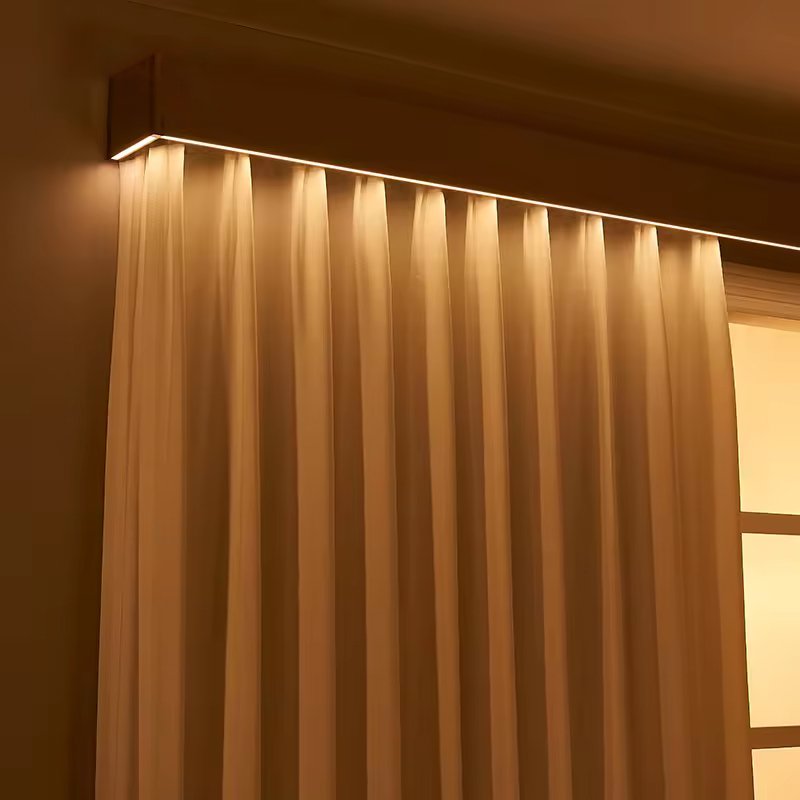
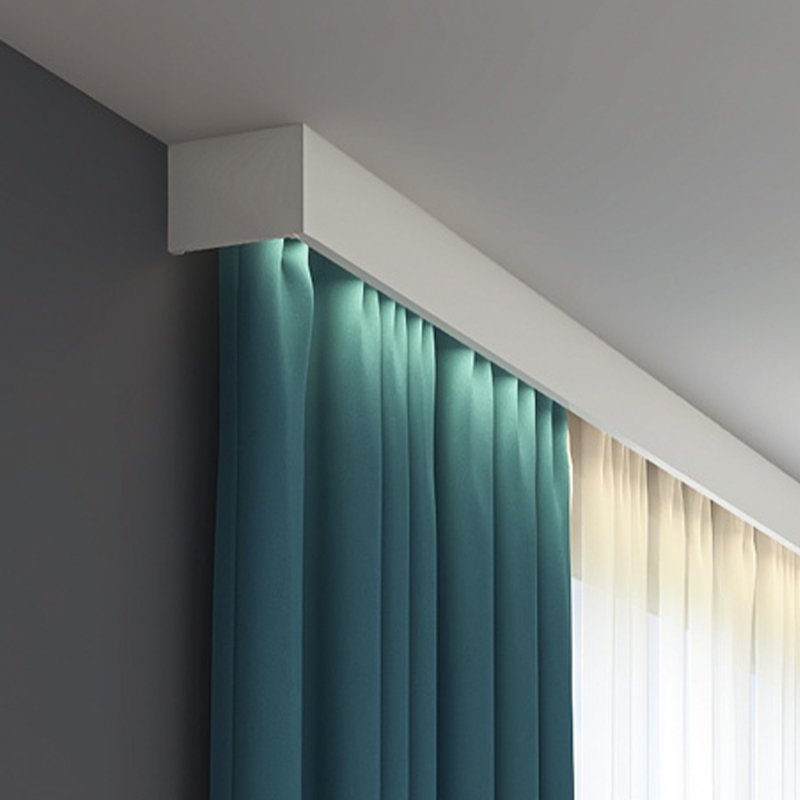
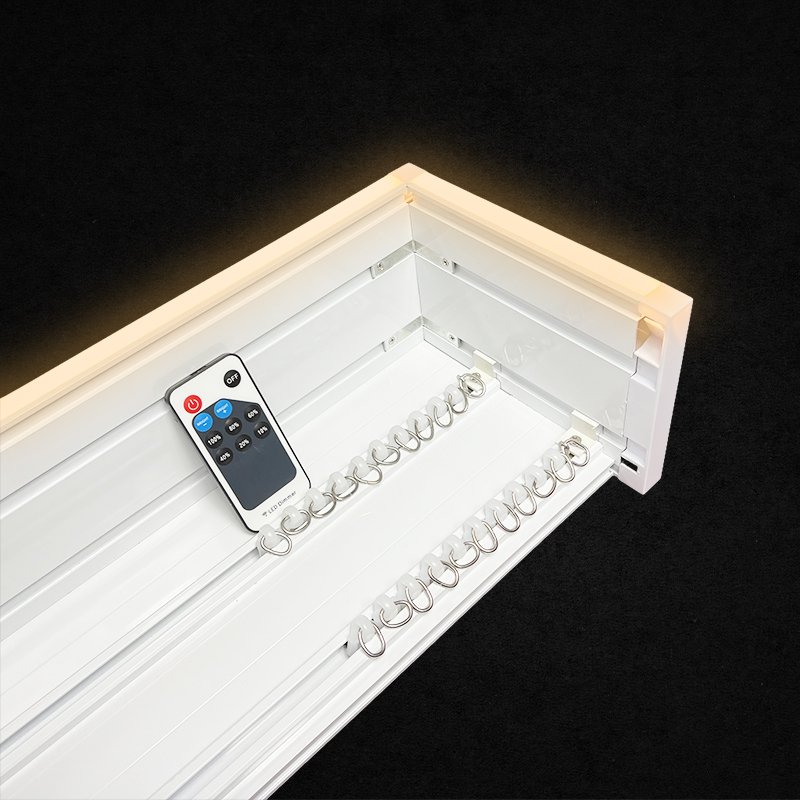
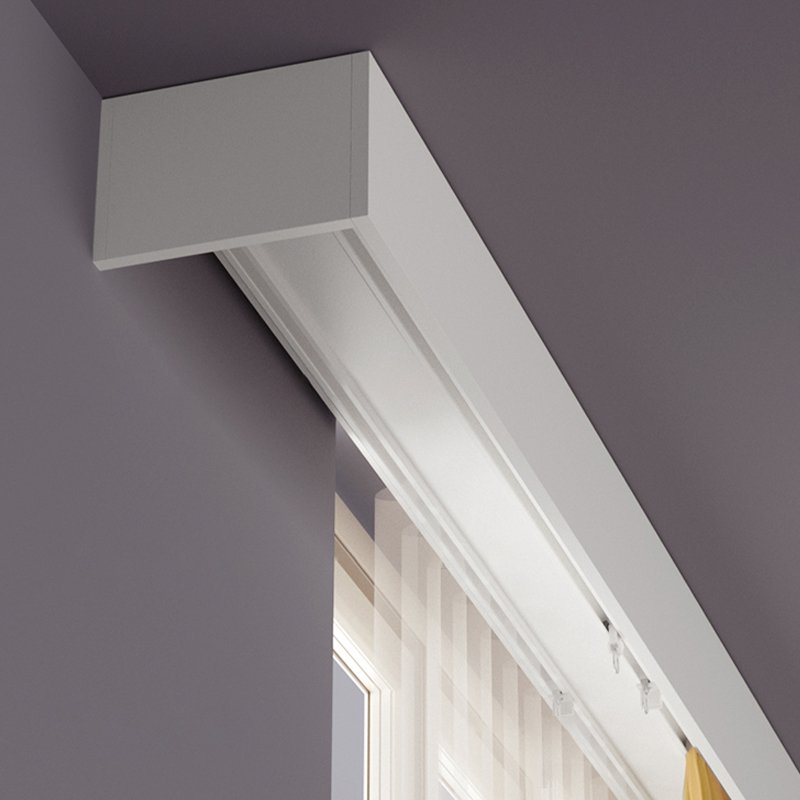
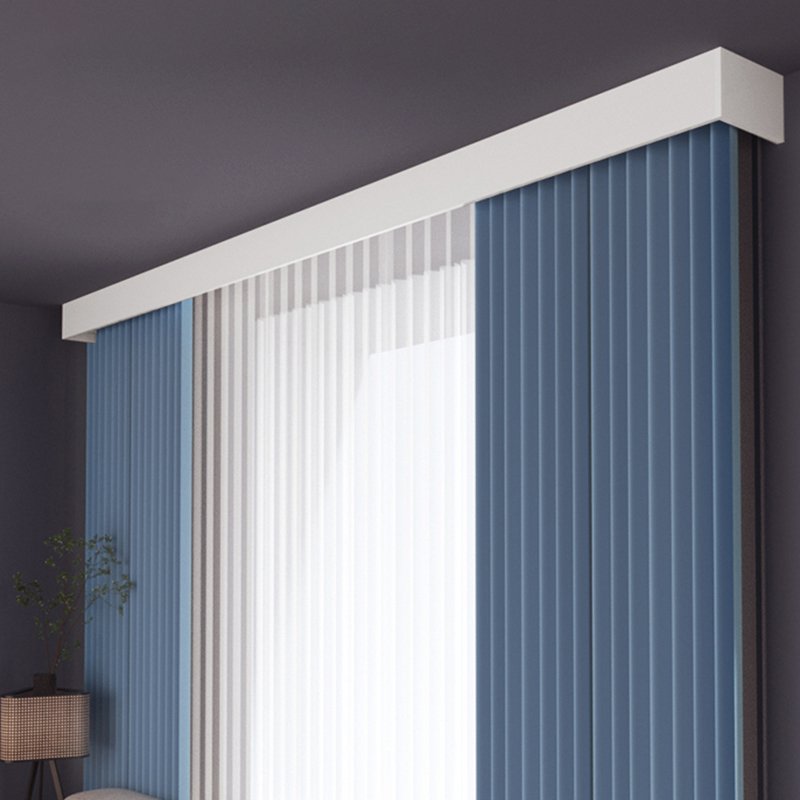
A curtain pelmet that hides the motorized track and carries the LED: the curtain is lit from inside the box rather than from the ceiling. Surface mounted, made to the opening, with the light and the drive specified together.A curtain pelmet that does two jobs at once: it hides the track, and it carries the light. The motorised track sits inside the box, the LED runs along the underside, and the curtain is washed from above instead of lit from the ceiling.
Nothing about the hardware is on show — no track, no gliders, no motor housing. What the room sees is a clean horizontal line at the ceiling and a curtain that appears to be lit from within.
This product has three names depending on who is asking. In the UK and much of Europe it is a pelmet. In Asia and in a lot of contract documentation it is a curtain box. In older American specification writing it is a cornice. Interior designers will sometimes call a fabric-covered version a window pelmet and the rigid version a box.
They describe the same idea: a rigid enclosure above the window that conceals the track and finishes the top of the curtain. Worth knowing when you are comparing quotes, because two suppliers can be pricing the same object under different words.
Lighting a curtain from the ceiling above it flattens the fabric and throws a hard line across the top of the window. Lighting it from inside the pelmet does the opposite: the LED sits close to the curtain and runs parallel to it, so the folds are grazed from above and the whole drop reads as textured rather than flat.
That is the argument for pelmet lighting over a ceiling wash, and it is why the detail shows up in hotel rooms and bedrooms where the curtain is the main soft surface in the room. A curtain pelmet is the only part of the window that can do this without a visible fitting. Warm output on a heavy fabric reads as a lit wall; cooler output on a sheer reads as daylight.
The profile, the gliders and the drive are all concealed within the pelmet. The curtain hangs from the internal track and exits through the open underside, so the only visible parts are the fabric and the light.
Because the drive is enclosed, the pelmet has to be designed around the track rather than added afterwards — the internal depth, the position of the track within the box, and the gap the curtain passes through are all decided together. That is why a curtain pelmet from us is supplied as one system rather than as a box plus a track from two suppliers who have never spoken.
The box fixes below the ceiling rather than being set into it. That is the practical difference from a recessed track: a recess has to be built into the ceiling before the plaster goes on, whereas a curtain pelmet can be installed in a finished room.
It also means the pelmet becomes a visible design element rather than a shadow gap. Matte white for a ceiling that disappears; a dark bronze or timber finish where the pelmet is meant to read as a deliberate line above the window — both are made to order.
Two things have to be decided at quotation, because they are built into the same box: the light and the drive.
How the light is switched — with the room lighting, or on its own — is part of the same conversation, because it is wired inside the box rather than added later. Both are settled before the box is made; changing either afterwards means remaking the pelmet, not swapping a component.
A pelmet is one of four approaches to motorized curtains. If the ceiling is finished and you are weighing a pelmet against a recessed track or an open lit track, the comparison is here: motorized curtains explained.
Yes — it is made to the opening, not cut from a stock length. Send the width, the ceiling height available for the box, and the curtain drop; the internal depth follows from the track and the fabric rather than from a fixed size.
Yes, that is the point of a surface-mounted box. The only requirement is a sound fixing at the ceiling line and enough projection for the curtain to hang clear of the wall.
That is settled at quotation, not on site. Tell us whether the light should come on with the room lighting or on its own switch, and we will confirm how the box is built to suit — the wiring is inside the pelmet, so it cannot be changed once the box is made.
The motorised track is inside the box, so access is designed in rather than assumed. How the pelmet opens for service is part of the specification — worth asking about on any curtain pelmet with a motor inside, because it is the detail most suppliers leave until it matters.
Yes. The pelmet is rigid and finished in a painted or timber finish; the curtain is yours. If you want the pelmet fabric-wrapped to match, that is a different construction and is quoted separately.
The LED sits inside the box, facing the curtain, so from normal standing height you see the wash on the fabric rather than the source. From directly below, close to the window, you can see into the underside — which is why the diffuser detail matters and is specified with the box.
Send the opening width, the ceiling height available for the box, the curtain fabric and whether the pelmet should read as part of the ceiling or as a deliberate line. Every curtain pelmet enquiry comes back with the box, the internal track and the light specified together.
© 2025 R & C Fuzhou Houseware Co., Ltd.
We will arrange for a sales manager to contact you immediately.