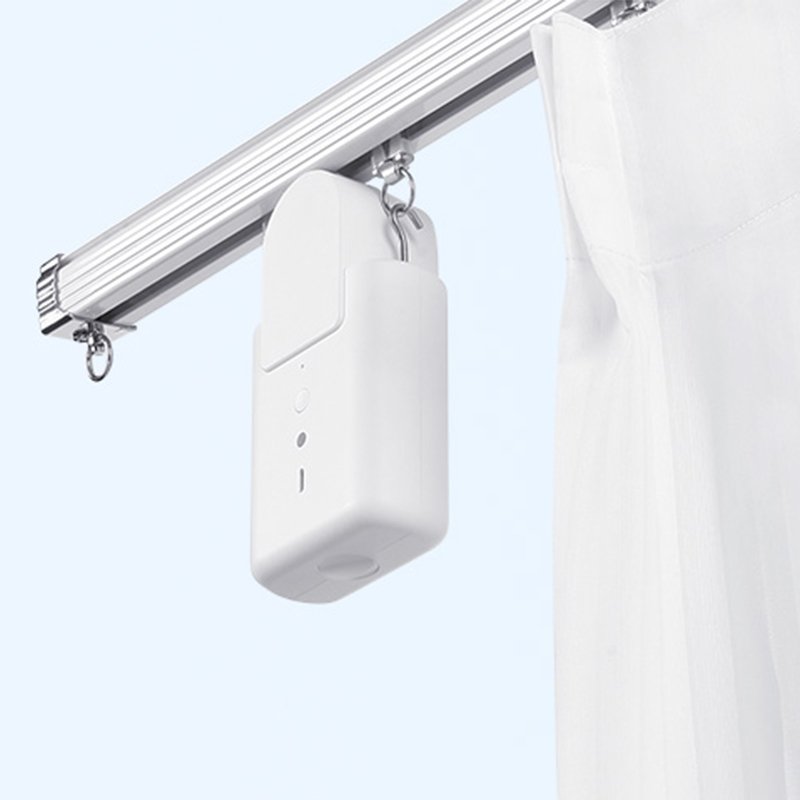
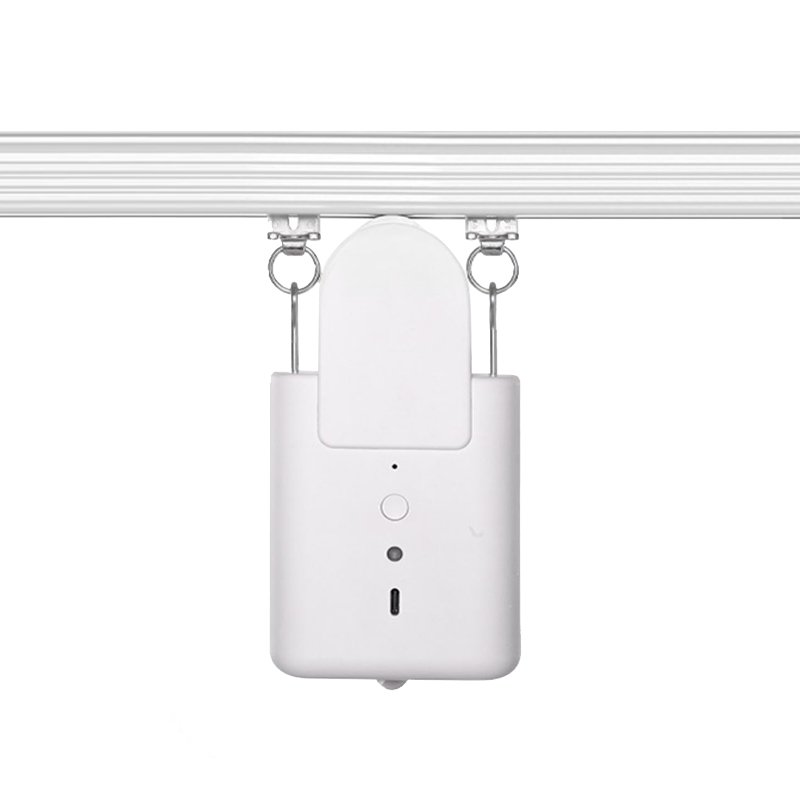
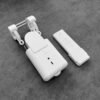
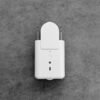
A battery automatic curtain opener that hangs on an existing curtain track and moves the curtain from a handset. No wiring and no track replacement: it clips on, charges over USB, and suits hotel refits, rentals and any room where chasing a cable is not an option.An automatic curtain opener for rooms where the track already exists and the wiring does not. The unit hangs from the track, holds the leading edge of the curtain and travels with it, so the curtain opens and closes from a handset instead of from across the room.
This is the retrofit answer. Nothing is cut into the wall, no cable is chased to the window, and the track the room was built around stays exactly where it is.
Once a curtain is already hanging on a track, there are two ways to make it move. You can drive the track itself: a motor sits at one end and pulls the gliders through a belt or a gear coupling, which is what our curtain motor does. Or you can leave the track alone and hang a self-contained opener on it that grips the curtain and walks it along.
That second approach is what a curtain robot is. It is a battery device with its own drive, its own control and no relationship to the mains. It solves a different problem from a track motor: not “how do I move a curtain”, but “how do I move this curtain, in this room, without touching the building”. That distinction is the one worth holding on to when an automatic curtain opener is compared with a motorized track.
The bracket straddles the track and the body hangs below it, in line with the curtain. The curtain’s leading edge is clipped to the unit, so the drive travels along the track and the fabric follows.
Practically, that means the existing track, brackets and curtain all stay. For a refurbishment that is the whole point: the room does not need to be taken out of service, the ceiling does not need to be opened, and the curtains do not need to be re-made. An automatic curtain opener fitted this way is usually the cheapest version of the project that still delivers the brief.
Track profiles vary more than buyers expect, so compatibility is confirmed per project — a photo of the track profile from the end is usually enough for us to say yes or no before quotation.
The unit runs on a rechargeable battery and charges over USB. There is no mains connection at the window and no low-voltage cable to run back to a cupboard, which is the constraint that usually kills an automatic curtain opener project in a finished building.
One practical note: the position has to be reachable at least occasionally, because the unit comes down to charge — worth agreeing at survey stage rather than after installation.
If the project does have power at the window and the client wants a drive that never needs charging, the wired route is a track-end motor, and a motorized ceiling curtain track is the cleaner specification.
The handset is the standard control: open, stop and close, from anywhere in the room. A single button on the body gives local operation for installation and for the day the handset is on the wrong table, and an LED indicates the state.
Where a room has more than one opening, each unit answers to the handset on its own, so a remote control curtain opener installation does not mean every curtain in the suite moving at once.
Buyers searching for a smart curtain opener usually want app or voice control. The honest answer is that this is a module choice, not a different device: where the project needs it, the smart module is specified at quotation stage rather than added afterwards.
Usually, but it is confirmed rather than assumed. Send a photograph of the track profile taken from the cut end and we will tell you before quotation. The unit needs a track with a runner channel the bracket can sit on; it is not a universal fit and we would rather say so now.
No. The unit is battery powered and charges over USB, so there is no fixed wiring and nothing to certify. That is the main reason an automatic curtain opener is specified where cabling is refused.
That depends on the curtain you are actually hanging, which is why we ask for the fabric before quoting. Sheer and standard lined curtains are not the same load as interlined blackout, and the drive is matched to the curtain rather than to the window.
No, and the difference matters when you specify. A curtain motor is built into or onto the track and drives the gliders through a belt or gear coupling — it is part of the hardware, and it needs power at the track. A smart curtain robot is a self-contained unit that hangs on a track that already works and travels with the curtain. One upgrades the track; the other adds a mover to it.
With the smart module, specified at quotation stage. It is worth being clear that the module is a control option on the same hardware — a motorized curtain opener that will not take a module is not something we supply, but the module itself is a per-project choice, not a default.
No — this unit needs a track to ride. For poles, the drive has to live inside the pole, which is what the motorized curtain rod does.
Send the track profile photograph, the curtain weight and the opening width, and we will confirm the unit, the channel count and the lead time. Every automatic curtain opener enquiry is answered with a specification, not a catalogue page.
© 2025 R & C Fuzhou Houseware Co., Ltd.
We will arrange for a sales manager to contact you immediately.